Torah of Reality.
A return to seeing.
If Torah is the blueprint of creation, how could Torah have ended up as religion?
Torah Without Religion — Journey Back to Soul
Bought the first edition? The Second Edition is yours at no additional cost. Check your original Gumroad purchase link or library. If you cannot find it, email info@jke.co.za.
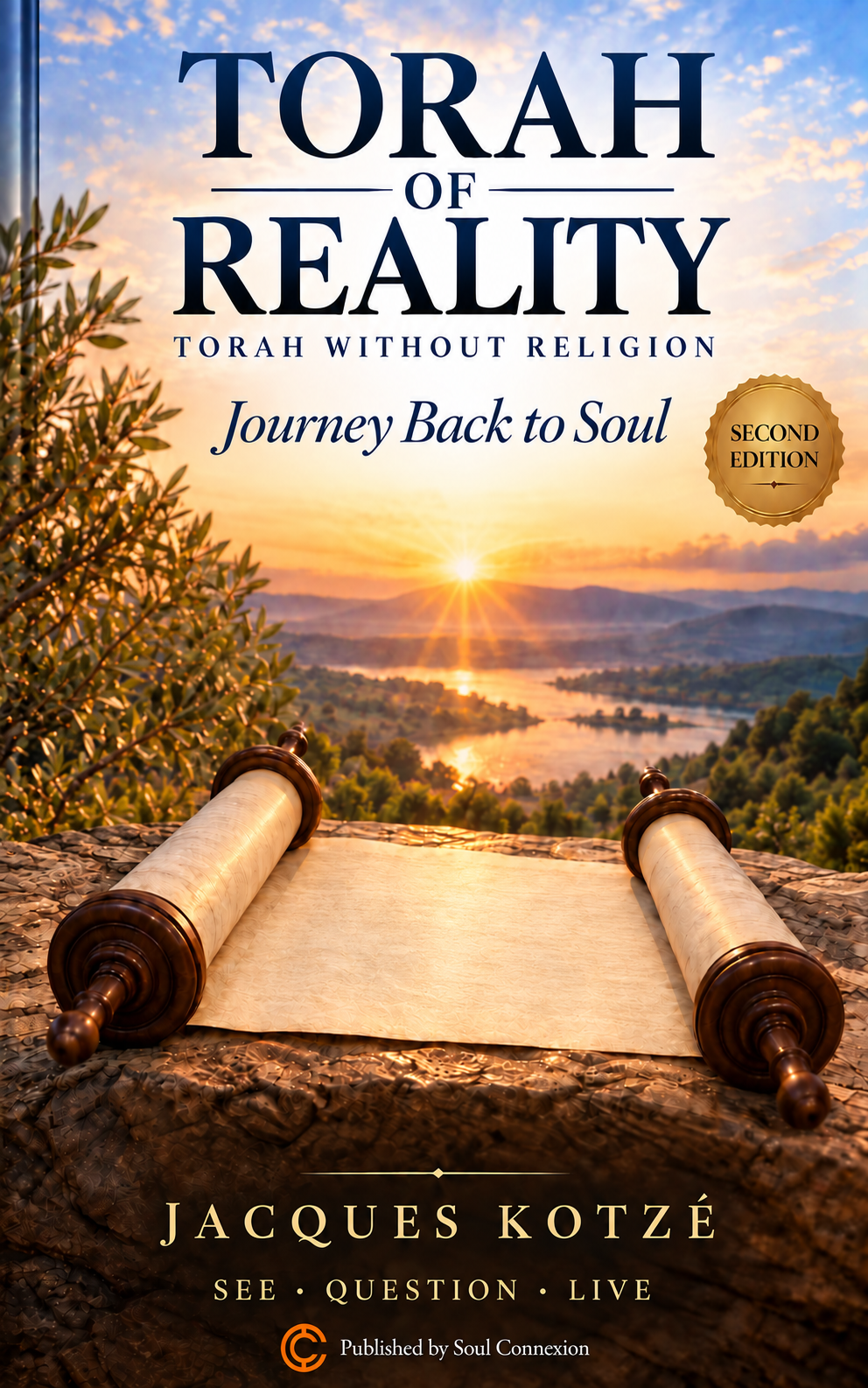
One book. Two starting points.
The word blueprint points to an order within creation. The book follows that image into a living reality that moves, develops and responds. Soul brings the question home: what if the deepest separation was never in the soul itself, but in our perception?
The Second Edition follows these questions into relationships, work, suffering and choice. It invites you to test the stories you have inherited and the ones you have made for yourself.
Notice what happened before deciding what it means.
Test the explanation you have inherited or made for yourself.
Take the next honest step, then let reality answer.
What do I mean by Torah as the blueprint of creation?
Here is where the book begins: with the patterns already moving through life, and with a question about how to describe something alive.
From “The Blueprint of Creation: Torah as the Architecture of Existence,” printed pages 5–6.
Before there was a scroll, there was a song. Before there were words carved into tablets, there was already a pattern woven into creation, and before Sinai echoed with thunder, reality itself was already moving according to Torah.
Look around you. Every sunrise follows a rhythm. A seed carries within itself the possibility of the tree it will become. Your heart beats without waiting for you to remember to make it beat, seasons turn without consulting us, and life continually takes form according to patterns human beings did not invent. We can observe those patterns, study them, describe them, and sometimes learn how to work with them, but we did not put them there. Long before we developed language to explain reality, reality was already happening.
This is where my understanding of Torah begins. When I speak about Torah in this book, I am not speaking only about a scroll, a collection of commandments, or the religious structures that developed around them. I am speaking about the wisdom underlying reality itself: the intelligence through which creation takes form, develops, relates, changes, and moves toward what it can become. Torah, from this perspective, is not simply something that tells us about reality. It is the architecture through which reality unfolds.
The Midrash says that God looked into the Torah and created the world. I do not understand this as God opening a book and following a set of instructions. The teaching points toward something much deeper: Torah precedes our descriptions of it because Torah is woven into creation itself. The world does not merely contain examples of Torah that we can discover if we know where to look. Creation itself reveals Torah.
For years I used the word blueprint to describe this, and I still find the word useful, but over time I began to see its limitation. A blueprint sounds static. It suggests a finished drawing sitting on a table while someone constructs a building according to its design. Reality does not behave like a finished drawing. It is alive, constantly moving, developing, responding, becoming and passing away. The structure matters, but so does the movement within the structure.
A companion for questions the page cannot answer.
The Book Companion helps readers examine ideas from the book and bring their own questions to them. Its role is to help you distinguish what you know from what you assume, and to return you to life beyond the screen.
Available to readers who have purchased Torah of Reality. Your copy of the book explains how to request access in Chapter 13.
The current Book Companion is available until 11 December 2026. Your purchased book remains yours. I will share a new plan for Companion access after that date.
Look again at what you think you know.
The Second Edition is ready. Written by Jacques Kotzé and published by Soul Connexion.
Get the Second Edition on Gumroad · $12Digital PDF · 242 pages · Immediate download
Soul Connexion by Jacques Kotzé
Where Torah of Reality meets ordinary life.